Elicit vs Consensus vs Perplexity: Which Should You Use First?
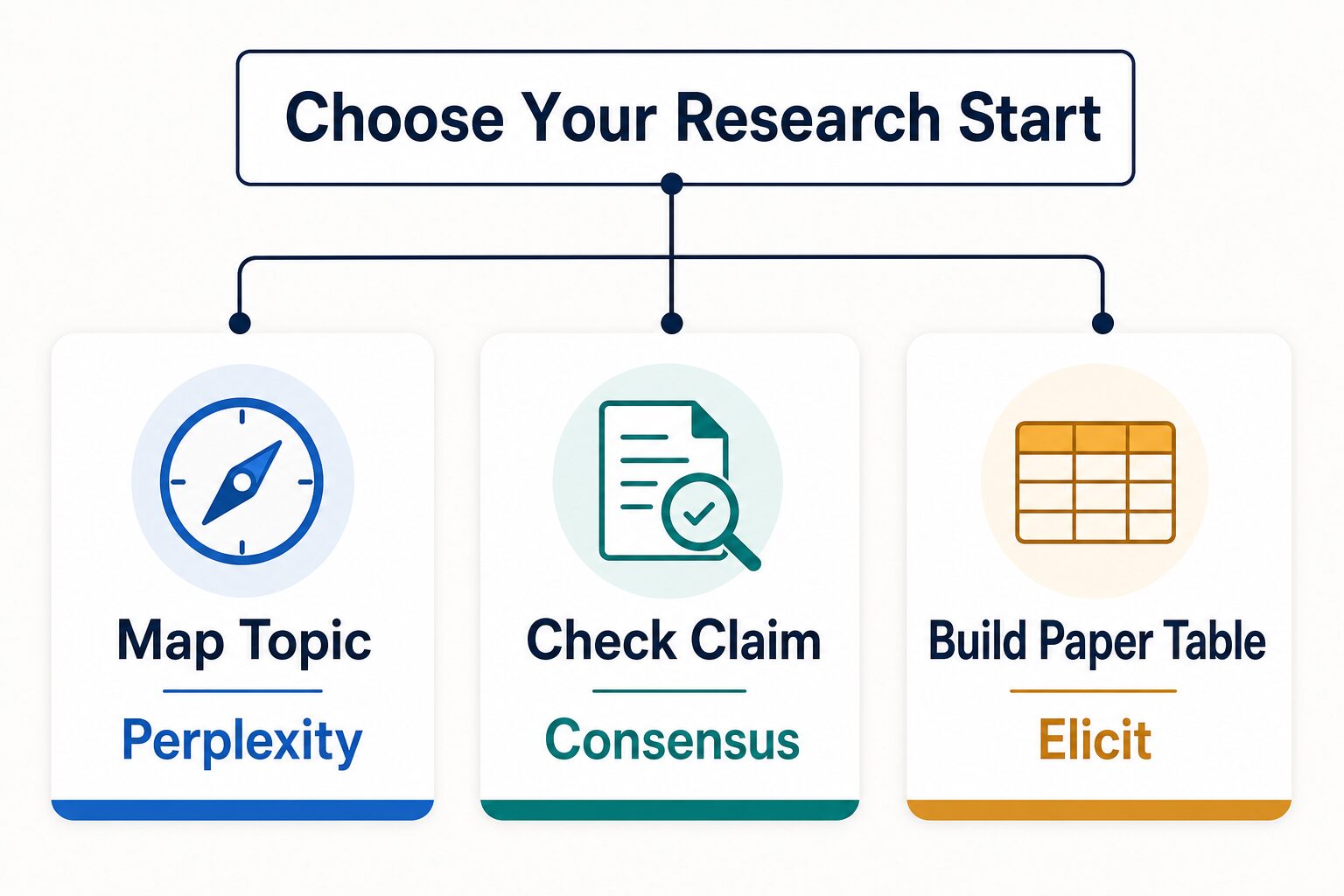
If you are comparing Elicit vs Consensus vs Perplexity, choose by the research job in front of you. Start with Perplexity to map a broad or current topic, Consensus to check what peer-reviewed literature says about a claim, and Elicit when you need to search, screen, and extract information from a set of papers.
There is no universal winner because these tools solve different parts of research. This comparison was refreshed on July 10, 2026 from official product, pricing, help, privacy, security, and responsible-AI pages. It is official-research-only, not a paid-plan accuracy benchmark.
Quick Verdict: Which Should You Use First?
Use Perplexity first when you need vocabulary, recent context, and source leads. Use Consensus first when your question is already evidence-shaped. Use Elicit first when you have a focused question and need a repeatable paper-review workflow.
If you are still unsure, write your next task as a verb: map the topic, check the claim, or build the paper table. That verb is a better buying guide than a generic feature count.
| Tool | Open it first when | Main source surface | What it does not remove | Skip or compare first if |
|---|---|---|---|---|
| Perplexity | You need a fast map of a current, broad, or cross-domain topic. | Cited web answers, files on supported plans, and premium sources on some paid plans. | Opening the sources, identifying primary evidence, and checking dates and context. | You need a reproducible peer-reviewed search or structured study extraction. |
| Consensus | You want to know what peer-reviewed research says about a specific claim or question. | Scientific papers retrieved before AI synthesis, with citation-backed answers. | Reading important papers, checking study design, and deciding whether the evidence fits your claim. | Your sources must include news, policy, company, legal, or market material outside the research literature. |
| Elicit | You need to find papers, screen a set, extract fields, create reports, or organize a review. | Academic papers and structured paper-level workflows. | Defining inclusion criteria, checking extracted fields, and defending the final paper set. | You are still exploring the topic or mainly need current web context. |
The Real Difference Is the Research Stage
Broad web discovery, evidence synthesis, and structured literature review are related, but they are not interchangeable. A cited web answer can help you learn the vocabulary of a field without giving you a complete academic search. A peer-reviewed synthesis can help you check a claim without defining your review protocol. A paper table can organize studies without proving that your search found every relevant source.
That is why this page does not rank the three tools by a vague idea of answer quality. The more useful question is: what evidence do you need next, and what manual review can you perform after the AI response?
For a wider tool list, see our guide to AI research tools for graduate students and our comparison of AI literature review tools. Those pages cover more options; this page stays focused on the three-way opening decision.
How We Compared Elicit, Consensus, and Perplexity
We used five criteria that matter after the novelty wears off:
- Starting task: orientation, claim checking, or paper-set work.
- Source boundary: broad web sources, peer-reviewed papers, or structured academic records.
- Human review burden: what you still need to open, read, classify, or verify.
- Plan fit: whether a free surface is enough to test the workflow before paying.
- Privacy boundary: whether consumer, education, enterprise, and API promises differ.
We did not run paid-plan output tests or calculate accuracy scores. Product facts below come from official sources; workflow recommendations are editorial judgments based on the job each product says it supports.
Perplexity: Best for Mapping a Broad or Current Topic
Perplexity is the most natural first stop when the topic is still messy. It can help you identify terminology, current debates, public sources, organizations, and opposing claims before you narrow the research question. Its current plan pages describe cited answers on the free plan, with higher limits, advanced models, files, apps, and premium data sources on paid plans.
That breadth is useful, but it creates the main risk: citations can come from sources with different authority levels. A government report, company press release, journal article, news story, and SEO summary should not be treated as equivalent evidence just because they appear in one answer.
Choose Perplexity if: you need current context, cross-domain source discovery, or a fast vocabulary map. Skip it as your only tool if: your method requires peer-reviewed-only retrieval, explicit inclusion criteria, or structured extraction across a paper set.
For a deeper source-discovery comparison, read Perplexity vs Google for research workflows.
Consensus: Best for Checking a Research Claim
Consensus is the clearest fit when your question already sounds like a research claim: Does an intervention improve an outcome? What does the literature say about a relationship? Which studies support or challenge a conclusion?
The official Research Agent documentation says it can combine citation crawling, DOI lookup, author search, similar-paper discovery, filters, study comparisons, and gap analysis, then return answers grounded in peer-reviewed research. Consensus also states that AI synthesis begins after literature retrieval, which is an important source boundary.
That boundary does not make every summary final. You still need to confirm that the papers match the population, intervention, outcome, time period, and claim you intend to make. A real paper can still be irrelevant, weak, old, underpowered, or summarized too broadly.
Choose Consensus if: you need a fast peer-reviewed evidence check and want citations close to the answer. Skip it as your only tool if: the assignment also requires legislation, market evidence, company information, news, or other non-academic sources.
For a narrower comparison, see Elicit vs Consensus for research papers or the full Consensus review.
Elicit: Best for Building and Reviewing a Paper Set
Elicit becomes more useful when you already have a focused question and the research object is a set of papers. Its current pricing page describes paper search, Research Agent and Reports, systematic-review workflows, extraction columns, exports, alerts, API access, and team collaboration across tiers.
The practical advantage is structure. Instead of ending with one fluent answer, you can move toward a table of papers, methods, populations, interventions, outcomes, findings, and limitations. That makes Elicit the strongest first choice here for screening and extraction work.
The structure does not define the review method for you. You still need a defensible question, search boundary, inclusion and exclusion criteria, duplicate handling, extraction rules, and a final source audit.
Choose Elicit if: you need repeatable paper-level work. Skip or delay it if: you are still learning the topic vocabulary or your evidence set must include current public-web sources.
Read our Elicit review for a single-tool decision, or compare NotebookLM vs Elicit for literature reviews if you already have a source pack.
A Same-Question Three-Pass Test Before You Pay
Use one real question from your work rather than three different demo prompts. For example:
How does asynchronous remote work affect collaboration quality in small knowledge-work teams?
- Perplexity pass — map the topic. Ask for key terms, competing definitions, recent public evidence, and primary-source leads. Save only the sources you can identify and open.
- Consensus pass — check the evidence claim. Narrow the question to a testable relationship and inspect the retrieved papers, populations, methods, and dates.
- Elicit pass — build the paper table. Use the focused question to collect papers and define extraction columns such as sample, work setting, study design, outcome, and limitation.
The winner is not the tool that writes the longest answer. It is the tool that moves your evidence one stage forward with a source trail you can still audit.
Original-value test: repeat the same question on each free surface before paying. Note which stage creates friction: broad discovery, peer-reviewed filtering, paper extraction, export, collaboration, or privacy approval. Upgrade only when the blocked stage is central to your recurring work.
Free Plans and Paid-Plan Boundaries
| Tool | Free-plan signal checked July 10, 2026 | Paid-plan boundary to verify | Buying rule |
|---|---|---|---|
| Elicit | Basic is free and includes limited Research Agent/Report usage plus paper search and source viewing. | The live page shows Plus, Pro, Scale, and Enterprise variants; billing and segment views can change displayed prices and limits. | Pay when repeated reports, systematic-review workflow, extraction depth, exports, alerts, API, or collaboration is the actual bottleneck. |
| Consensus | Free includes paper searches plus limited Pro messages, Deep reviews, and Study Snapshots. | Official Help Center lists Pro at $15/month or $120/year and Deep at $65/month or $540/year; Teams and Enterprise differ. | Pay when advanced searches or review limits interrupt a recurring evidence-check workflow. |
| Perplexity | Free is $0/month with cited answers and limited use of higher-capability features. | Current individual pricing shows Pro at $20/month and Max at $200/month; education, enterprise, and API products are separate. | Pay when higher limits, files, apps, advanced models, premium sources, or sustained research use are necessary. |
Prices, taxes, billing periods, education eligibility, and limits can change. Treat these as a dated orientation and verify the live checkout before subscribing.
The Five-Point Source Audit
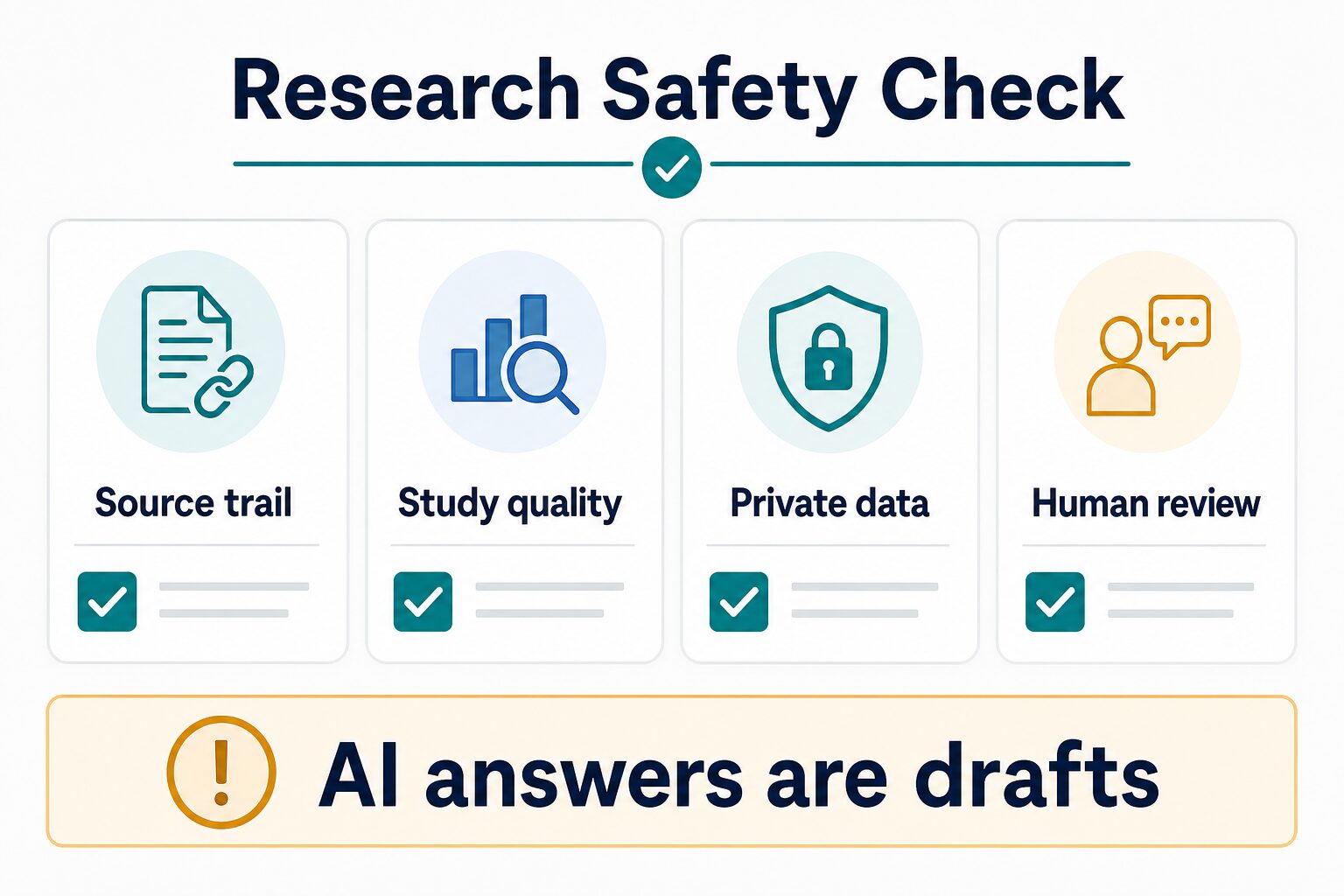
Run this audit before a tool-generated answer enters a thesis, report, client deliverable, policy memo, or public article:
- Source identity: Is it a primary study, review, official document, news report, company page, or commentary?
- Claim fit: Does the source support the exact statement, or only a narrower or adjacent claim?
- Study quality: Are the design, sample, population, limitations, and conflicts appropriate for the conclusion?
- Date and context: Is the evidence current enough, and does it apply to the country, industry, or population in your work?
- Permission and privacy: Are you allowed to upload the material, store the query, and use the result in this setting?
A fluent summary is not a substitute for this audit. Consensus can keep the answer close to peer-reviewed papers, Elicit can keep the paper set structured, and Perplexity can expose a broad source trail, but none of them decides whether your final claim is defensible.
Privacy: Do Not Mix Consumer, Enterprise, and API Claims
Before uploading unpublished papers, client files, interview transcripts, student records, medical information, legal material, financial data, or employer-confidential documents, confirm that your institution or client allows the upload.
Elicit’s public privacy policy describes personal-data collection and processing, while some stronger no-training and security language appears on its enterprise pricing surface. Consensus says user data is not used to train AI models and describes anonymized query handling. Perplexity documents zero data retention for the Sonar API, but that API promise should not be generalized to every consumer-account workflow.
Use our AI tool privacy checklist for professionals before you upload work data. If the policy is unclear, use public or synthetic material for the trial and keep confidential sources in an approved system.
Which Tool Fits Graduate Students and Knowledge Workers?
For a graduate student starting a literature review
Use Perplexity carefully for vocabulary and current context, then move to Consensus for evidence checks and Elicit when you are ready to build and screen the paper set. Do not cite an AI summary when the assignment requires the original source.
For a knowledge worker writing a client or policy brief
Perplexity may be the best first step because the evidence set can include official reports, regulation, news, company material, and academic work. Use Consensus for scientific claims, and use Elicit if the brief becomes a structured literature-review project.
For a team with a controlled research process
Start with data policy, account administration, retention, export, and collaboration requirements. A lower individual subscription price is not the deciding factor if the plan lacks the controls your organization requires.
Elicit vs Consensus: The Narrower Decision
If Perplexity is already out of the decision, choose between Elicit and Consensus by the artifact you need at the end of the session.
| Research job | Start with | Do not stop at |
|---|---|---|
| Build a candidate paper set and structured evidence table | Elicit | The extracted fields without checking the paper |
| Ask a narrow claim question and inspect the cited evidence direction | Consensus | The answer summary without opening the sources |
| Prepare a systematic or publishable review | Elicit for organization, then a documented review protocol | Any AI tool as the inclusion or quality authority |
| Handle unpublished, confidential, or regulated material | Your approved research environment | A consumer tool before policy and privacy review |
Neither tool replaces reading the papers. A safer pilot uses one broad search, one narrow claim question, and one known paper that lets you check whether the system retrieves and represents evidence as expected.
FAQ
Is Elicit better than Consensus?
Elicit is usually the better fit for building and extracting from a paper set. Consensus is usually the better first fit for checking what peer-reviewed literature says about a question. Choose by workflow, not a universal ranking.
Is Consensus better than Perplexity for academic research?
Consensus has a clearer peer-reviewed-literature boundary. Perplexity is broader and can be more useful for current web orientation. For an academic claim, use Perplexity to map the topic and then inspect peer-reviewed evidence directly or through a research-focused tool.
Which tool is best for a systematic literature review?
Elicit is the most directly aligned of the three because its product and plan pages describe systematic-review workflow, screening, extraction, reports, and paper-level organization. You still need a defensible method and human review.
Can I use the free plans before paying?
Yes. All three have a free surface. Run the same real question through the relevant stage, document the limit you hit, and pay only if that limit blocks recurring work.
Are AI research citations automatically reliable?
No. A citation can be real but irrelevant, weak, outdated, or summarized too broadly. Open the source, check claim fit and study quality, and keep a human review step.
Does this comparison include paid-plan testing?
No. This is an official-research-only workflow comparison refreshed on July 10, 2026. It does not claim paid-plan benchmarking, accuracy testing, or output-quality rankings.
Final Recommendation
Start with Perplexity to map a broad or current topic, Consensus to check a research claim against peer-reviewed literature, and Elicit to build, screen, and extract from a paper set. Use more than one only when each tool has a defined stage.
The safest workflow is not the one with the most AI features. It is the one that leaves you with an auditable source trail, a clear privacy boundary, and a human-reviewed conclusion.
Try the Workflow Before You Subscribe
Use one real, non-confidential question on the free surfaces, then compare the stage each tool completes. Check the live terms before paying.
Check Elicit plans · Check Consensus plans · Check Perplexity plans